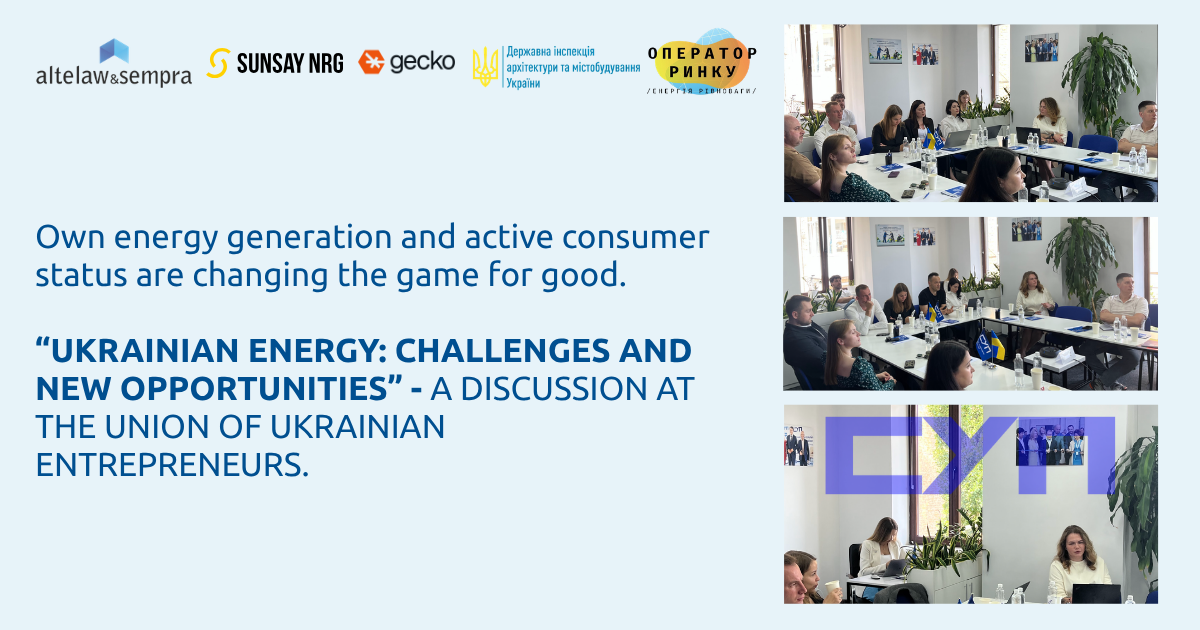
Olha Savchenko, Senior Partner at Altelaw&Sempra, participated in the DiXi Group panel discussion “Energy Security Talks: Summer Outlooks,” which focused on navigating the summer season and developing decentralized energy in Ukraine.
The law addresses market demand, but it arrived late.
“The law is generally positive. It is a response to the proposals and needs of the market. However, it emerged in the fifth year of the war. Given the urgent need for private investment in energy, we must move faster with both primary legislation and the secondary regulatory framework under it,” Olha Savchenko noted.
- New Opportunities for Auctions: The deadline for conducting auctions has been extended until 2035, the entry threshold for participants has been lowered, and issues regarding technical non-compliance of already constructed facilities have been resolved. Additionally, project implementation deadlines have been extended to account for martial law. A new category has been introduced for SPP (Solar Power Plant) + ESS (Energy Storage Systems) auctions with a price cap of €12/MWh. The auction quota for 2026 is set at 1 GW.
- A Systemic Shift to Market Premium: A vital structural change is that while the auction mechanism previously functioned as a contract for difference, it now operates as a pure market premium. “This is exactly what the market wanted and what is needed,” Olha comments.
- The Counterparty Issue: However, a fundamental problem remains with the counterparty. The State Enterprise “Guaranteed Buyer” remains the counterparty under the auction model—an institution with accumulated debts dating back to 2022 and subsequent years. Due to a lack of institutional trust in this mechanism, European investors and financial institutions view it with inherent skepticism. Resolving the debt problem is a task that should have been handled yesterday.
- Flexible Grid Connection: The law codifies the possibility of utilizing existing substation capacities with the subsequent scaling up of connection capacity. Secondary regulation is actively being developed. However, in practice, the approaches of different DSOs (Distribution System Operators) vary significantly, which highlights the need to strengthen control mechanisms and accountability for timely and quality obligation fulfillment.
- “Connecting Everyone to Everyone”: The new configuration allows consumers, producers, and various types of generation to interact with one another, opening up the opportunity to utilize available capacities on the consumer side.
- The ESS Gap: Energy Storage Systems (ESS) added to a producer gain the right to preferential tariffs for distribution, transmission, and dispatch, but they do not have the right to charge from the grid without obtaining separate technical specifications. Given the large volume of already constructed solar facilities that require balancing, this bottleneck slows down the incentives for developing ESS alongside such facilities.
- Bilateral Agreements for Gas Cogeneration: The law has enabled the conclusion of such contracts. At the same time, combining this rule with existing price caps does not create sufficient conditions for developing decentralized gas generation next to consumers.
- Guarantees of Origin: The law has regulated the possibility of their recognition. The full operationalization of this tool could potentially open up opportunities for exporting electricity at a higher price.
Legislative progress is real. However, the speed of adopting secondary regulations, resolving the debt problem of the Guaranteed Buyer, and refining the rules for ESS remain critical conditions for the new rules to truly serve as a green light for investment.
Altelaw&Sempra supports renewable energy, ESS, and energy facility construction projects at all stages: from obtaining permits and documentation to commissioning and market entry.