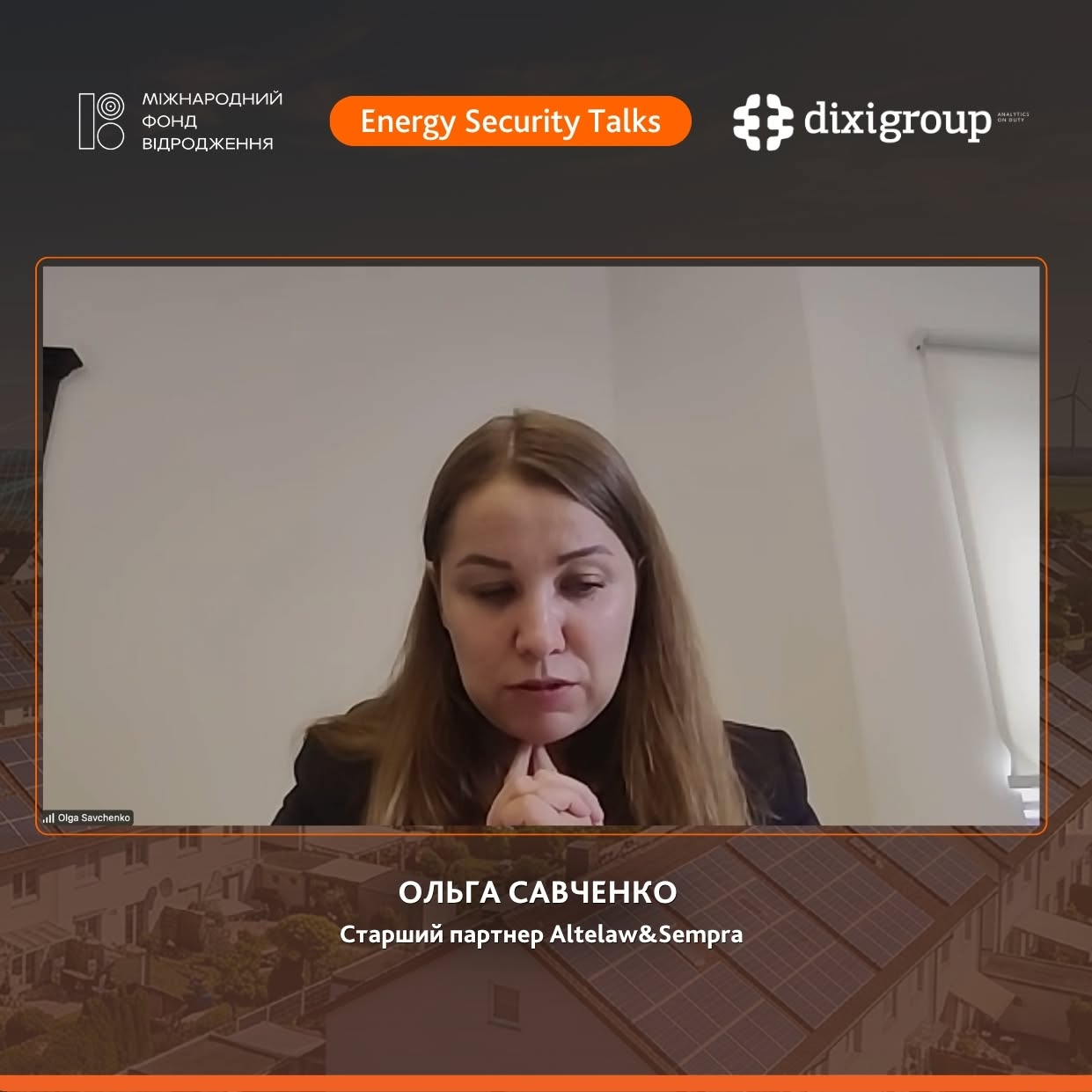
Olha Savchenko, senior partner at Altelaw&Sempra
The market for investments in energy projects for individuals in Ukraine is still at an early stage of development, but with each quarter the number of offers is becoming noticeably larger. Previously, mechanisms for attracting investment existed, but small financing was hardly developed, and energy itself was perceived as a closed and poorly understood area for a private investor. The situation was changed by the war. It affected the perception of energy in general, and the appearance on the market of players who began to popularize small project financing for individuals made such a model noticeable. Following it, in various variations, investment began to be offered by energy market participants as well.
The first thing to find out is the legal form in which the investment opportunity is organized. It is this form that determines how well the funds are protected and whether a clear procedure for their return is provided. Various offers coexist on the market:
- an investor can enter a limited liability company with their own funds for a certain percentage,
- join an energy cooperative,
- invest funds through a corporate or mutual investment fund, which from a legal point of view remain the most safe and reliable mechanism.
In each individual case, it is necessary to examine how the legal model of the project is constructed, and based on this, draw a conclusion about the feasibility of the investment. In parallel, legislation on energy communities is being finalized, which will open up another possible form of investment with the participation of a local government body, an investor, and a developer.
Special attention should be paid to the developer and contractor who implement the project. Construction and launching of energy facilities require practical knowledge, so the project must be backed by people with real experience. It is also important to understand where the project is located, what status the land plot or building has, whether they correspond to the intended purpose, and whether it is even possible to place the corresponding facility there. Likewise, it is worth checking the technical conditions of connection and assessing whether the declared cost and economic model correspond to the expenses that will have to be incurred for the launch. The reliability of the contractor will show how likely it is that the project will be built with quality and on time.
Any investment in such projects carries risk, and it is impossible to guarantee a one-hundred-percent payback. Even if you turn to a contractor with a request to install a storage system for a large building, different contractors will offer different costs for the equipment, different operational conditions, and different payback calculations. On large projects, the logic is the same. There are mainly two risks here:
- high price volatility on the electrical energy market, which depends on many factors, including the behavior of large players,
- the result is affected by martial law, constant shelling, and damage to the energy system. If the enemy disables a transmission point, the facility will not be able to deliver electricity until the repairs of the substation are completed.
Because of these factors, the promised yield is often overstated. It is more realistic to somewhat reduce expectations and separately evaluate how qualitatively a trader will be able to sell the generated electricity. A quality trader will not sell the entire volume on the balancing market, where the debt to participants remains significant.
A separate issue is how risky it is to invest funds in a project at the construction stage. In practice, investing in an apartment at the construction stage is riskier than in an energy facility. If an energy facility is already under construction, it usually means that the issue with the land plot is resolved, there are technical conditions and an understanding of the connection procedure, the equipment is ordered, and it remains to be assembled and launched. If the work is not completed by one contractor, it can be performed by another.
If we talk about payback, currently the most attractive look to be electrical energy storage installations, provided that the investor enters the project before May 1, 2027. After this date, the conditions for paying the tariff for distribution, transmission, and dispatching for such facilities will change, and their economics will become less attractive. Solar and wind power plants, as well as gas piston units, remain profitable primarily in a model where the facility operates for a specific consumer: it is built next to a factory or production line, a direct agreement is concluded, and electricity is supplied at an agreed price.
Regarding the legislative protection of investors’ rights, a corporate or mutual investment fund remains the most correct and reliable form today. They are transparent and understandable, although more expensive for the one who invites to invest. Often energy cooperatives are chosen, but this is already a somewhat archaic form of capital attraction.
Investing in energy opens up real opportunities, but requires careful analysis of legal risks, technical conditions, and key project participants even before investing funds. The Altelaw&Sempra team accompanies energy projects at all stages, from assessing the legal model to structuring investor participation and attracting financing.
If you are considering an investment in an energy project, contact us, we will check the project for risks. If you are preparing your own project to attract funds, we will help build the structure so that the model complies with the requirements of the legislation and is sustainable over time.